
Gold Eagles
-
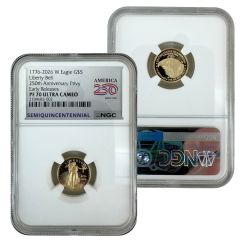
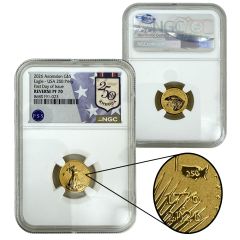
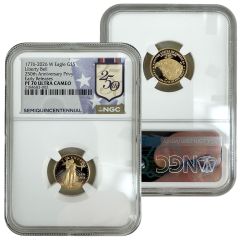 1776-2026 $5 Proof Gold American Eagle – PF70SKU: 0107249Status: Out of stockQuick ViewOut of stock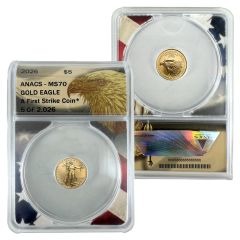
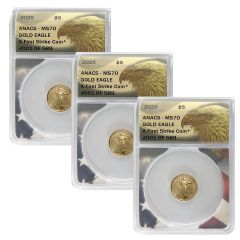
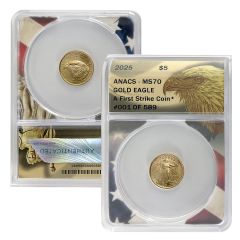
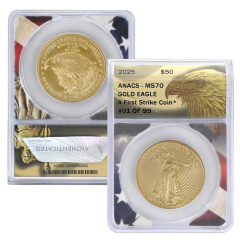 2025 $50 Gold American Eagle - ANACS NumberedSKU: 0105678Status: Out of stockQuick ViewOut of stock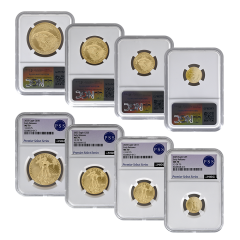
 2025 $50 Gold American Eagle - NGC Numbered Split PaySKU: CT00103Status: Out of stock
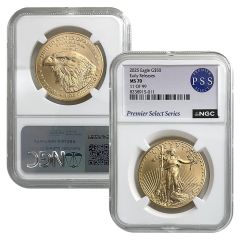
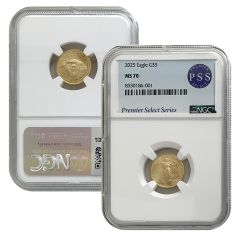
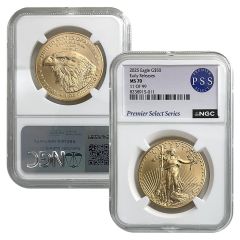 2025 $50 Gold American Eagle - NGC NumberedSKU: 0105675Status: Out of stockQuick ViewOut of stock
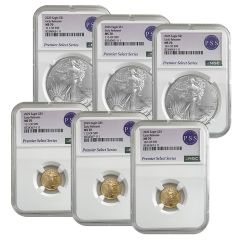 2025 Silver Eagle & $5 Gold Eagle x3 - NGC Numbered PairSKU: 0105780Status: Out of stockQuick ViewOut of stock
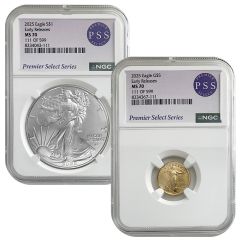 2025 Silver Eagle & $5 Gold Eagle - NGC Numbered PairSKU: 0105686Status: Out of stockQuick ViewOut of stock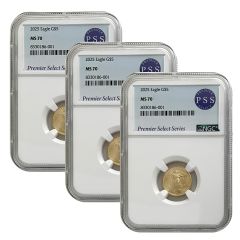
 Newsletter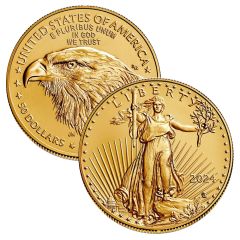
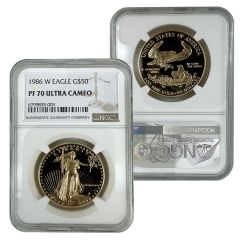
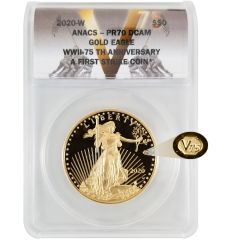
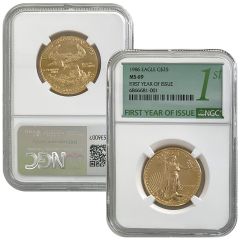 1986 First Year of Issue $25 Gold Eagle - NGC MS69SKU: 031199Status: Out of stock
What Are American Gold Eagle Coins?
American Gold Eagle coins are official United States legal tender gold bullion coins authorized by the Gold Bullion Coin Act of 1985 and first issued by the United States Mint in 1986. Each coin contains its stated weight in actual fine gold, alloyed with small amounts of silver and copper to achieve 22-karat (91.67%) purity, making them among the most durable government-issued gold coins in the world.
Gold Eagles are produced at the West Point Mint and carry the full backing of the U.S. government for weight, content, and purity. Whether you're stacking bullion for precious metal ownership or building a date-run collection of proof issues, the American Gold Eagle series offers a format suited to every goal.
American Gold Eagle Coin Design History
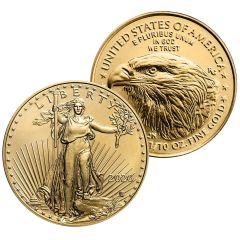
The Gold Eagle's obverse carries one of the most celebrated designs in American coin history. Sculptor Augustus Saint-Gaudens created the original striding Liberty for the 1907 $20 Double Eagle, a design widely considered the most artistically significant ever placed on a U.S. coin. That same image was adapted for the Gold Eagle series at its 1986 launch: Lady Liberty strides forward, torch raised in her right hand, an olive branch in her left, with the U.S. Capitol visible in the background.
Two Reverse Types of the American Gold Eagle - Type I and Type II
The series has used two distinct reverse designs in its history:
- Type I (1986–2021): Features a Family of Eagles, with a male eagle carrying an olive branch as it approaches a female eagle sheltering hatchlings in a nest. Designed by Miley Busiek, this reverse defined the series for 35 years.
- Type II (2021–Present): Features a close-up eagle portrait in left profile, rendered in exceptional detail by Jennie Norris. The Type II transition also brought a refined obverse closer to Saint-Gaudens' original 1907 relief. The 1 oz Type II bullion coin also introduced an interrupted reeded edge security feature not found on fractional sizes.
Collectors building date sets now span two visually distinct eras, with Type I coins increasingly sought for their historical design character.
American Gold Eagle Denominations and Sizes
The American Gold Eagle program offers four standard sizes, each with a nominal legal-tender face value. The actual gold value far exceeds these face values at any current spot price.
Size Value Gold Content Weight (grams) 1 oz $50 1 troy oz fine gold 33.931 g 1/2 oz $25 1/2 troy oz fine gold 16.966 g 1/4 oz $10 1/4 troy oz fine gold 8.483 g 1/10 oz $5 1/10 troy oz fine gold 3.393 g The 1 oz Gold Eagle is the flagship denomination. It is the only size offered in all three finishes (Bullion, Proof, and Burnished) and is the most widely traded format on the secondary market. The $50 face value also makes it the highest face-value denomination currently struck for ongoing annual bullion production by the U.S. Mint.
Fractional Gold Eagles (1/2 oz, 1/4 oz, 1/10 oz) are issued annually in Bullion and Proof finishes. They are issued in lower mintages than the 1 oz coin and represent an accessible entry point for collectors building denomination sets.
Stacker's note: Fractional sizes carry higher premiums per troy ounce over spot than the 1 oz coin. The 1 oz format typically delivers the best per-ounce cost for bullion collecting. Fractional coins are best suited for collector sets, gifting, or denomination-run completions.
The Three Gold Eagle Finishes Explained
Understanding finish types is essential for both stackers and collectors. Each finish has distinct production methods, mintage levels, and collecting appeal.
Bullion (Brilliant Uncirculated) Gold Eagles
Standard bullion Gold Eagles are struck on standard planchets using normal die pressure. They carry no mint mark and are distributed through an authorized dealer network — not sold directly by the U.S. Mint. Bullion coins track gold spot prices closely, with premiums determined by market demand and dealer margins.
Bullion Eagles are the most liquid format in the series. They trade globally, are accepted by precious metals IRAs without special authentication, and are produced in quantities determined by market demand. The U.S. Mint is legally obligated to strike enough bullion Eagles to satisfy public demand, a requirement that does not apply to collector strikes.
Proof Gold Eagles
Proof Gold Eagles are the premium collector format. They are struck multiple times on specially polished planchets using hand-selected dies, producing the signature cameo effect: frosted, sculpted devices contrasting against mirror-polished fields. Each proof coin is individually inspected and encapsulated before sale.
Proof Eagles carry a "W" mint mark for the West Point Mint and are sold directly by the U.S. Mint at a premium over bullion value. Annual mintages are significantly lower than bullion issues, and certain years carry strong numismatic premiums on the secondary market.
In 2026, the Proof Gold Eagle carries two historic distinctions: a dual date of 1776–2026 marking the U.S. Semiquincentennial, and a Liberty Bell privy mark, the first dual date ever to appear in the Gold Eagle series. The $10, $25, and $50 proof denominations in 2026 also represent the highest-denomination American gold coins ever struck with a dual date.
Burnished (Uncirculated) Gold Eagles
Burnished Gold Eagles occupy a middle ground between bullion and proof. The planchets are polished before striking, creating a satin-like, matte appearance distinctly different from both the brilliant bullion finish and the mirror-cameo proof. Burnished Eagles bear a "W" mint mark and are sold by the U.S. Mint as collector coins, but without proof-level inspection.
The Burnished format was introduced in 2006 for the series' 20th anniversary and has been issued in varying years since. Currently, only the 1 oz size receives the Burnished finish. Burnished fractional Gold Eagles (issued 2006–2008) are notably scarce and carry numismatic premiums above their gold content.
Certified Gold Eagles: PCGS and NGC Grading
Certification transforms a raw Gold Eagle into a graded, authenticated, encapsulated coin, commonly called a "slab." Third-party grading by PCGS (Professional Coin Grading Service) or NGC (Numismatic Guaranty Company) provides independent verification of:
- Authenticity – confirmed genuine, not counterfeit
- Grade – condition assessed on the Sheldon 1–70 scale
- Strike quality – sharpness and die quality documented
- Eye appeal – exceptional specimens may receive Star (★) designations (NGC) or Plus (+) grades (PCGS)
American Gold Eagles Grading Scales
Grade Designation What It Means MS-70 Perfect Uncirculated No post-production imperfections under 5× magnification MS-69 Near-Perfect One or two minor contact marks MS-68 Exceptional Uncirculated A few small marks, still premium quality PF-70 Perfect Proof Flawless proof coin PF-69 UC Near-Perfect Proof Minor imperfections, Ultra Cameo designation SP-70 Perfect Burnished Applies to Burnished/Uncirculated format Why Certification Matters for Gold Eagle Collectors
A raw bullion Eagle is straightforward to trade at spot-plus-premium. A certified example, especially in MS-70 or PF-70, commands a measurably higher premium because the grade is locked and independently verified. For collectors building registry sets or date runs, certified coins provide documented condition history that affects long-term numismatic value.
For IRA accounts: Bullion Eagles do not require grading for IRA eligibility. Certified coins in slabs are generally held outside IRAs due to their numismatic premium.
Key Dates and Rarities in the Gold Eagle Series
Not all Gold Eagle years are equal. Certain dates carry premiums above their gold content due to low mintage, production anomalies, or historical significance.
Year / Issue Note 1995-W Proof $5 Gold Eagle Issued only in the 10th Anniversary 5-Coin Set — one of the rarest modern U.S. gold coins 1999-W Unfinished Proof Die Issues $5 and $10 struck from unfinished proof dies; distinct frosty surfaces with "W" mint mark 2008 & 2009 (Collector Versions) Proof and Burnished production suspended; U.S. Mint dedicated full capacity to bullion demand 1991, 1992, 1999 (select denominations) Low bullion mintages — especially 1/2 oz and 1/4 oz — with growing collector demand 2020-W V75 Privy 1 oz Proof WWII 75th Anniversary privy mark; 1,945 struck — among the lowest-mintage Gold Eagles ever 2021 Type I / Type II Transition Both reverse types struck in 2021; Type I "final year" issues carry strong collector demand 2026 40th Anniversary Issues Dual date, Liberty Bell privy mark, laser-engraved master dies — a milestone year for the series Who Should Collect Gold Eagles and Which Format Fits You?
For the Bullion Stacker
Bullion Gold Eagles are the most recognized, most liquid, and most dealer-accepted format for precious metal ownership. Buy by the ounce, by the tube (20 coins), or by the Monster Box (500 coins). No certificate, no slab, no premium beyond spot-plus-dealer margin. Clean and efficient.
Best choice: 1 oz Bullion Gold Eagle, current-year issue
For the Date-Set Collector
Build a complete set by year, tracking design changes from Type I (1986–2021) to Type II (2021–present). Include one of each denomination per year, or focus on a single denomination across all years. Certified grades add an extra layer of completeness.
Best choice: PCGS or NGC graded examples by year in MS-69 or MS-70
For the Proof Collector
Annual Proof Gold Eagles are the Mint's finest work. The mirror-cameo finish, limited mintage, and official Mint packaging make them natural centerpieces for display collections. Focus on key-date proofs, low-mintage years, and special-issue releases for maximum numismatic depth.
Best choice: Proof Gold Eagles in PF-69 Ultra Cameo or PF-70 Deep Cameo — especially 1995-W $5, 2020-W V75, and 2026 dual-date issues
For the Fractional Collector
The 1/10 oz, 1/4 oz, and 1/2 oz denominations form a natural denomination set alongside the 1 oz. Annual 4-coin proof sets issued by the U.S. Mint make this an accessible and rewarding subcollection.
Best choice: Annual Proof 4-Coin Sets or individual fractional proofs graded PF-69 UC or higher
2026 American Gold Eagles: A Milestone Year for the Series
The year 2026 marks the 40th anniversary of the American Gold Eagle program (1986–2026) and coincides with the U.S. Semiquincentennial, the 250th anniversary of American independence.
Key distinctions for 2026 issues:
- Dual Date 1776–2026 on all Proof Gold Eagles (first time in series history)
- Liberty Bell privy mark honoring the 250th anniversary
- Laser-engraved master dies across all finishes (Bullion, Proof, Burnished), replacing the older hubbing process for sharper, more consistent strikes
- The 2026 Proof Gold Eagle $10, $25, and $50 are the highest-denomination dual-dated American gold coins ever struck
For collectors, 2026 is among the most event-driven years in the series' history, comparable in numismatic significance to the 1986 inaugural year and the 2021 Type II redesign.
Gold Eagle Authentication and Buying Guidance
Counterfeit Gold Eagles exist in the marketplace. Protect your collection by buying only from established, verifiable sources and applying these authentication practices:
- Weight check: A genuine 1 oz Gold Eagle weighs 33.931 grams. Any deviation is a red flag.
- Dimensions: 1 oz diameter is 32.7 mm; thickness is 2.87 mm.
- Edge reeding: Type II 1 oz Gold Eagles feature an interrupted reeded edge security gap.
- Coin testing: Reputable dealers use XRF (X-ray fluorescence) testing and/or Sigma Metalytics verification.
- PCGS/NGC slabs: Graded coins are sealed and can be verified by barcode or QR code at PCGS.com and NGCcoin.com.
- Mint packaging: Proof Eagles sold directly by the U.S. Mint includes a Certificate of Authenticity and the Mint's official presentation case.
FAQs for American Gold Eagles
1. What is a Gold Eagle?
The American Gold Eagle is the official gold bullion coin of the United States, first introduced in 1986. Each coin is struck in 22-karat gold, containing 91.67% pure gold alloyed with 3% silver and 5.33% copper for enhanced durability.
2. Where are American Gold Eagle coins minted?
American Gold Eagles are produced by the U.S. Mint, primarily at the West Point Mint in New York. Proof and Burnished editions are struck exclusively at West Point and carry the "W" mint mark. Standard bullion coins carry no mint mark.
3. How much does a Gold Eagle coin weigh?
Gold Eagles are available in four denominations:
- 1 oz — 33.931 grams total | 1 troy oz gold
- 1/2 oz — 16.965 grams total | 0.5 troy oz gold
- 1/4 oz — 8.483 grams total | 0.25 troy oz gold
- 1/10 oz — 3.393 grams total | 0.1 troy oz gold
Total coin weight is slightly higher than the stated gold content due to the silver and copper alloy.
4. Is the American Gold Eagle made of pure gold?
No. It is 22-karat (.9167 fine), meaning 91.67% gold alloyed with silver and copper for durability. The stated gold content, such as "1 oz Fine Gold," refers to actual gold weight only, not total coin weight.
5. Are American Gold Eagles legal tender?
Yes. Each denomination carries a U.S. government-assigned face value, $50 for the 1 oz, $25 for the 1/2 oz, $10 for the 1/4 oz, and $5 for the 1/10 oz. In practice, the actual gold value far exceeds these face values, so they are held as investment assets rather than spent as currency.
6. What is the difference between a Gold Eagle and a Gold Buffalo?
The Gold Eagle is 22-karat (.9167 fine) while the Gold Buffalo is 24-karat (.9999 fine), and both contain exactly 1 troy oz of gold. The Buffalo appeals to buyers requiring higher purity. The Gold Eagle offers fractional sizes, lower premiums, and broader U.S. dealer acceptance, giving it a clear liquidity advantage in the domestic market.
7. What is the difference between a Type 1 and Type 2 American Gold Eagle?
Type 1 Eagles (1986–2021) feature Miley Busiek's family of eagles reverse design. Type 2 Eagles (mid-2021 to present) feature Jennie Norris's detailed bald eagle portrait with updated die technology. Gold content, weight, and purity are identical in both. The 2021 transition year produced both versions, making it the most collectible year in the series.
8. How many Gold Eagles are minted each year?
Annual mintage varies based on investor demand. The U.S. Mint is legally required to produce enough bullion coins to meet public demand, so figures fluctuate year to year. Proof and Burnished editions are produced in significantly lower quantities, making certain years scarcer on the secondary market.
9. How much is an American Gold Eagle coin worth?
The value of a Gold Eagle is the current gold spot price plus a dealer premium. The 1 oz coin carries the lowest premium per troy ounce. Certified examples graded MS-70 or PF-70 by PCGS or NGC command higher premiums based on independently verified conditions.
10. How much more expensive is a 1/10 oz Gold Eagle per ounce than a 1 oz?
The 1 oz typically trades at a 3–5% premium over spot, while the 1/10 oz carries a 10–15% premium, a difference of roughly 7–12% per troy ounce. For the lowest cost-per-ounce, the 1 oz is the most efficient choice. Fractionals suit buyers who prefer a lower entry point or need to liquidate in smaller amounts.
11. Are American Gold Eagles IRA-eligible?
Yes. Gold Eagles are specifically named in IRS Code Section 408(m)(3)(A)(i) as approved assets for self-directed Precious Metals IRAs. All four denominations qualify, making them one of the most accessible options for tax-advantaged physical gold ownership.
12. Are American Gold Eagles taxable?
Yes. The IRS classifies Gold Eagles as collectibles. Coins held under one year are taxed at your personal income tax rate. Coins held over one year are taxed at the IRS collectibles rate of 28%. Consulting a qualified tax advisor for your specific situation is recommended.
13. Are Gold Eagle coins good for Collecting?
American Gold Eagles are widely regarded as one of the strongest physical gold collecting options. They are government-backed for weight, purity, and content, IRA-eligible, and accepted by dealers worldwide. Their long track record and deep secondary market liquidity make them a reliable foundation for any precious metals portfolio.
14. Where can I buy or sell American Gold Eagles?
Bullion Gold Eagles are sold through the U.S. Mint's authorized dealer network. Proof and Burnished editions are available directly from the U.S. Mint upon annual release. Gold Eagles are among the most liquid coins in the U.S. market, accepted by virtually all coin dealers, bullion exchanges, and online precious metals platforms.
15. Can I sell my American Gold Eagles back?
Yes. Gold Eagles are among the easiest gold coins to sell in the U.S. market due to their universal dealer recognition. When selling, compare current buyback prices across multiple reputable dealers to ensure competitive value. Tighter bid-ask spreads on Gold Eagles reflect their strong secondary market depth.